






CBD has become one of the best-known cannabinoids in the UK, but it is far from the only interesting compound found naturally in hemp.
CBG, or cannabigerol, is attracting increasing attention, and we are seeing more customers asking us about CBG UK products, CBG oil UK options and, most importantly, the difference between CBG and CBD.
So, when looking at CBG vs CBD, which should you choose?
The answer isn’t necessarily one or the other. CBD and CBG are different cannabinoids that interact with the body in different ways. For some people, a CBD-dominant product will make the most sense. Others may want to explore CBG, while some prefer products that contain both CBD and CBG alongside the other naturally occurring compounds found in hemp.
This guide explains what CBG is, how CBD oil vs CBG oil compares and why full spectrum products containing multiple cannabinoids have become increasingly popular.
What is CBG?
CBG stands for cannabigerol. It is one of the many naturally occurring cannabinoids found in Cannabis sativa, including hemp.
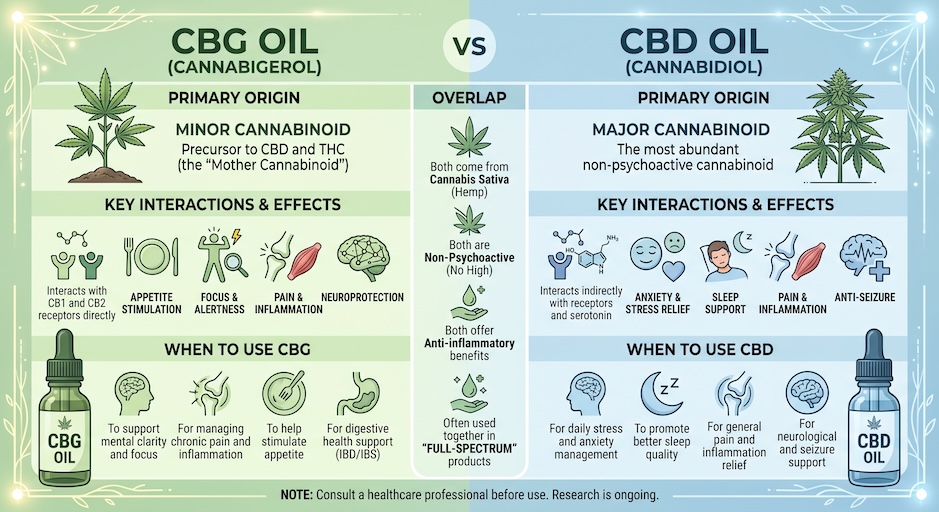
CBG is sometimes referred to as the “mother cannabinoid”. This comes from the role played by its acidic precursor, CBGA, within the plant. CBGA acts as an important precursor from which other cannabinoids, including CBD and THC, can ultimately be produced as the plant develops.
CBG is normally present in much smaller concentrations than CBD in mature hemp plants. This is one reason why dedicated CBG products have historically been less common and often more expensive to produce.
Like CBD, CBG is considered non-intoxicating. In other words, it doesn’t produce the characteristic “high” associated with THC.
Scientists are increasingly interested in CBG because it interacts with several biological targets, including components of the body’s endocannabinoid system. Research has identified interactions involving cannabinoid receptors, TRP channels and several other signalling systems.
However, CBG research is considerably less developed than CBD research. Much of the current evidence around potential CBG benefits comes from laboratory, animal and early-stage research rather than large, high-quality human clinical trials.
That distinction is important. CBG is an exciting area of cannabinoid research, but exciting research shouldn’t be confused with proven medical treatment.
What is CBD?
CBD stands for cannabidiol and is generally found at considerably higher concentrations in commercially cultivated hemp.
It is the cannabinoid most people encounter when they first start exploring hemp products and is available in many different forms, including CBD oils, pastes, gummies, balms, creams and massage oils.
CBD has also been researched much more extensively than CBG.
Both compounds interact with the body’s endocannabinoid system, but they don’t behave in exactly the same way. The endocannabinoid system is a complex signalling network involved in numerous physiological processes.
This difference in biological activity is one reason researchers are interested in studying individual cannabinoids rather than treating all hemp extracts as though they were the same thing.
If you’re exploring the wider range for the first time, you can shop all CBD products and compare the different ways cannabinoids can be incorporated into your daily routine.
CBG vs CBD: What is the main difference?
The simplest CBD oil vs CBG oil comparison is that they contain different dominant cannabinoids.
A CBD oil has CBD as its primary cannabinoid, while a CBG-focused oil contains a more significant concentration of CBG.
The difference goes deeper than the name on the bottle.
CBD and CBG have different molecular structures and interact differently with receptors and signalling pathways within the body. Scientific research suggests that CBG has activity at cannabinoid CB1 and CB2 receptors as well as several other biological targets, while CBD has its own complex range of interactions.
Neither CBD nor CBG should be thought of as simply a weaker version of the other.
They are different compounds.
There is also a major difference in how much research exists. CBD has received considerably more scientific and regulatory attention. CBG remains a relatively new area of research, particularly when it comes to high-quality human trials and long-term consumption.
This means you should be cautious about websites making dramatic claims about CBG benefits. There is promising research, but there is still a great deal scientists don’t know.
Why combine CBD and CBG?
This is where the comparison becomes particularly interesting.
Choosing between CBD and CBG doesn’t always have to mean choosing one cannabinoid and excluding the other.
Hemp naturally contains numerous cannabinoids alongside terpenes and other plant compounds. Whole Plant and full spectrum products attempt to retain a broader selection of these naturally occurring compounds rather than isolating a single cannabinoid.
This is associated with what is commonly called the “entourage effect”: the theory that different compounds within the plant may interact with one another and produce different effects from an isolated cannabinoid.
It remains an area of continuing scientific investigation, so it shouldn’t be treated as a guarantee that combining cannabinoids will always produce a better result.
Nevertheless, it explains why many experienced CBD customers become interested in products containing CBD and CBG rather than simply increasing the strength of their CBD oil.
What is full spectrum CBG oil?
A full spectrum CBG oil isn’t necessarily an oil containing CBG alone.
The term “full spectrum” generally describes an extract designed to retain a range of naturally occurring hemp compounds. Depending on the particular extract, this can include CBD, CBG, other minor cannabinoids, terpenes and legally permitted trace quantities of controlled cannabinoids.
That makes full spectrum CBG oil particularly interesting for someone who wants to explore CBG while retaining the wider cannabinoid profile associated with a whole-plant extract.
By comparison, an isolate-based product concentrates on one particular cannabinoid, while broad spectrum products are typically formulated to provide multiple hemp compounds while excluding THC.
There isn’t one format that is automatically right for everybody. The choice depends on what you’re looking for and whether avoiding THC entirely is important to you.
What are the potential CBG benefits?
This is an area where responsible information matters.
Laboratory and preclinical research has investigated CBG in relation to numerous biological processes, including inflammatory signalling, the nervous system and the endocannabinoid system. Researchers have identified a surprisingly broad range of molecular targets for CBG.
However, research into many potential CBG benefits remains preliminary.
A scientific review of CBG research describes considerable therapeutic potential but also highlights the need for further investigation into both its effects and safety in clinical settings. Anyone interested in the science can read this peer-reviewed review of CBG research.
For consumers, the important message is straightforward.
CBG is scientifically interesting, but it isn’t a miracle cure.
Be particularly cautious when you see CBG marketed online as something guaranteed to treat pain, anxiety, inflammation, cancer or another medical condition. The current evidence doesn’t justify those sorts of promises.
CBD oil vs CBG oil: Which should you choose?
If you’re completely new to cannabinoids, CBD will usually be the more familiar starting point simply because there are considerably more products available and much more information about it.
If you’ve already used CBD and are interested in exploring the wider cannabinoid profile of hemp, a product containing CBG may be worth investigating.
Some people specifically look for CBG-dominant products. Others prefer CBD and CBG together.
Rather than focusing exclusively on which cannabinoid is “stronger”, think about the complete formulation. Look at how much CBD and CBG the product actually contains, whether it is whole plant, full spectrum or broad spectrum, how it should be used and whether it has been independently tested.
Two bottles that both say “hemp oil” on the label can be completely different products.
This is why transparency and third-party testing matter.
What about CBD CBG paste?
CBD CBG paste is another option for people looking beyond conventional CBD oil.
A paste is a concentrated hemp extract and can provide a broader plant profile in a relatively small quantity of product. A CBD CBG paste can therefore appeal to more experienced customers looking for a concentrated combination of cannabinoids.
The important thing is to check the actual cannabinoid content rather than assuming that all pastes are equivalent.
Look at how many milligrams of CBD and CBG are present in the complete product and how much is delivered by the suggested serving. Percentage strength can be useful, but the milligram content makes comparisons between differently sized products much easier.
The same principle applies to oils. A 10ml bottle and a 30ml bottle with the same percentage strength don’t contain the same total quantity of cannabinoids.
Full spectrum CBD and the wider hemp plant
The growing interest in CBG is also helping people understand something important about CBD.
Hemp is much more than a source of one cannabinoid.
CBD may be the dominant cannabinoid in many products, but full spectrum CBD extracts can contain a much wider range of naturally occurring plant compounds.
For some customers, preserving this broader profile is precisely the attraction of Whole Plant and full spectrum products.
Other customers specifically want to avoid THC and may therefore prefer an appropriate broad spectrum alternative.
Neither decision should be based on whichever product has the largest number printed on the bottle. Understanding what is actually in the extract is far more useful.
Are CBD and CBG legal in the UK?
The UK cannabinoid market is regulated, and the rules surrounding cannabinoid food supplements are more complicated than simply saying that “CBD is legal”.
In Great Britain, ingestible CBD products fall within the novel foods regulatory framework. The Food Standards Agency maintains a public list relating to CBD products linked to applications progressing through the regulatory process.
There are also strict controls concerning THC and other controlled cannabinoids.
If you’re shopping for CBD or CBG products in the UK, buy from a reputable company that provides clear product information and appropriate laboratory testing rather than choosing an unknown product simply because it is cheap.
The Food Standards Agency’s current CBD guidance is a useful external resource for anyone who wants to understand the regulatory and safety position in more detail.
What about CBD dosage?
This is another area where UK guidance has changed.
The Food Standards Agency currently advises healthy adults to limit CBD consumption from food products to 10mg per day. This is precautionary guidance based on lifetime exposure rather than a suggestion that consuming more than 10mg creates an immediate acute risk.
The FSA also advises that certain groups, including people taking medication, people who are pregnant or breastfeeding, people trying to conceive and those under 18, should avoid consuming CBD.
If you have a medical condition or take medication, speak to an appropriate healthcare professional before using cannabinoid supplements.
CBG has not accumulated the same depth of human safety data as CBD, which is another reason to take a measured approach rather than assuming that more is automatically better.
Oils aren’t the only way to use CBD
Although CBD oil and CBG oil attract much of the attention, there are plenty of other ways to explore CBD.
For people who don’t enjoy holding oil in their mouth, our vegan CBD gummies provide a different format.
For people interested in incorporating a topical product into massage and body-care routines, our CBD massage oil offers another way of using CBD externally.
We also regularly run special offers, which are worth checking if you’re looking to try something new while keeping the cost down.
And if your interest in natural wellbeing extends beyond cannabinoids, you can explore our range of medicinal mushroom tinctures.
So, is CBG better than CBD?
We don’t think “which is better?” is the most useful question.
CBD has been researched much more extensively and remains the cannabinoid most people know. CBG is a fascinating minor cannabinoid with a growing body of scientific research behind it, but much more research is needed before many of the claims surrounding CBG can be established in humans.
The interesting development is the increasing availability of products that allow people to explore CBD and CBG together.
If you’re considering a full spectrum CBG oil or CBD CBG paste, pay attention to the cannabinoid profile, concentration, laboratory testing and serving information rather than choosing purely on strength.
Most importantly, don’t assume that a product containing more cannabinoids or a higher percentage is automatically better for you.
At Bristol CBD, we believe choosing a cannabinoid product should start with understanding what you’re buying and why you’re considering it.
If you’re unsure whether CBD, CBG or a combination of CBD and CBG is the right place to start, we’re here to help you understand the differences and make an informed choice.
You can shop all CBD products or contact Bristol CBD for help choosing the most appropriate option for you.
💚 About Bristol CBD
Bristol CBD is the most trusted CBD brand in the UK, with a 5 star rating on both Google and Trustpilot. Alongside our premium CBD products, we also offer a carefully curated range of high-spec functional mushrooms, including Lion’s Mane, Shiitake, Chaga and Reishi
At Bristol CBD we are committed to providing high quality, affordable CBD products together with friendly customer support. Bristol CBD is one of the few companies in the UK that has achieved full validation on the Food Standards Agency’s novel foods list for CBD products.
We pride ourselves on offering unparalleled customer service, support, and advice, backed by a 100% money-back guarantee if you’re not completely satisfied with your product.
If you have any questions about buying or using CBD or medicinal mushrooms, feel free to call us anytime on 07706 031 935. We’re always happy to share our experience and help you find the best solution for your personal needs.
Please note: our staff are not qualified doctors or nurses, and we do not make medical claims or recommend CBD for specific ailments. All content is based on scientific research and years of practical experience. We always encourage speaking with your GP or healthcare provider before starting any new supplement.