





If you are new to CBD, one of the first confusing things you may notice is the number of different terms used to describe CBD products. You might see CBD extract, CBD oil, CBD paste, CBD isolate, broad spectrum CBD and full spectrum CBD, sometimes all on the same website.
So, what do they actually mean, and which type of CBD should you choose?
CBD extract is essentially the starting material used to create many CBD products. It is produced by extracting cannabidiol (CBD) and, depending on the extraction method, other naturally occurring compounds from hemp. That extract can then be refined, concentrated or combined with a carrier oil to create different types of CBD products.
Understanding the difference between these products is particularly important when comparing standard and high-strength CBD oil. A percentage on a bottle tells you about the concentration of CBD, while the number of milligrams tells you how much CBD the product contains in total.
In this guide, we explain CBD extract in straightforward terms and look at the differences between CBD oil, CBD paste, CBD isolate, full spectrum CBD and broad spectrum CBD.
What Is CBD Extract?
CBD, short for cannabidiol, is one of a group of naturally occurring compounds known as cannabinoids. It is found in hemp and cannabis plants, although the CBD products legally sold as food supplements in the UK are subject to specific regulatory requirements.
A CBD extract is produced when CBD and other selected compounds are extracted from plant material. The exact composition of the resulting extract depends on the raw material and the extraction and refinement processes used.
This matters because not every CBD extract is the same.
Some extracts retain a wide range of naturally occurring cannabinoids, terpenes and other plant compounds. Others are refined to remove certain components. At the other end of the scale, CBD isolate is highly purified so that the finished ingredient consists almost entirely of CBD.
The UK Food Standards Agency describes CBD as one of many chemicals called cannabinoids and explains that CBD extracts can be derived from hemp or cannabis plants and selectively extracted to concentrate CBD. The FSA also classifies CBD foods and food supplements as novel foods and maintains guidance for consumers and a register of CBD products linked to novel food applications.
For further independent information, you can read the Food Standards Agency’s guidance on CBD here: https://www.food.gov.uk/safety-hygiene/cannabidiol-cbd
How Does CBD Extract Become CBD Oil?
CBD extract and CBD oil are closely related, but they are not necessarily the same thing.
CBD extract is the concentrated material obtained through extraction and processing. CBD oil is generally created by combining an appropriate CBD extract with a carrier oil.
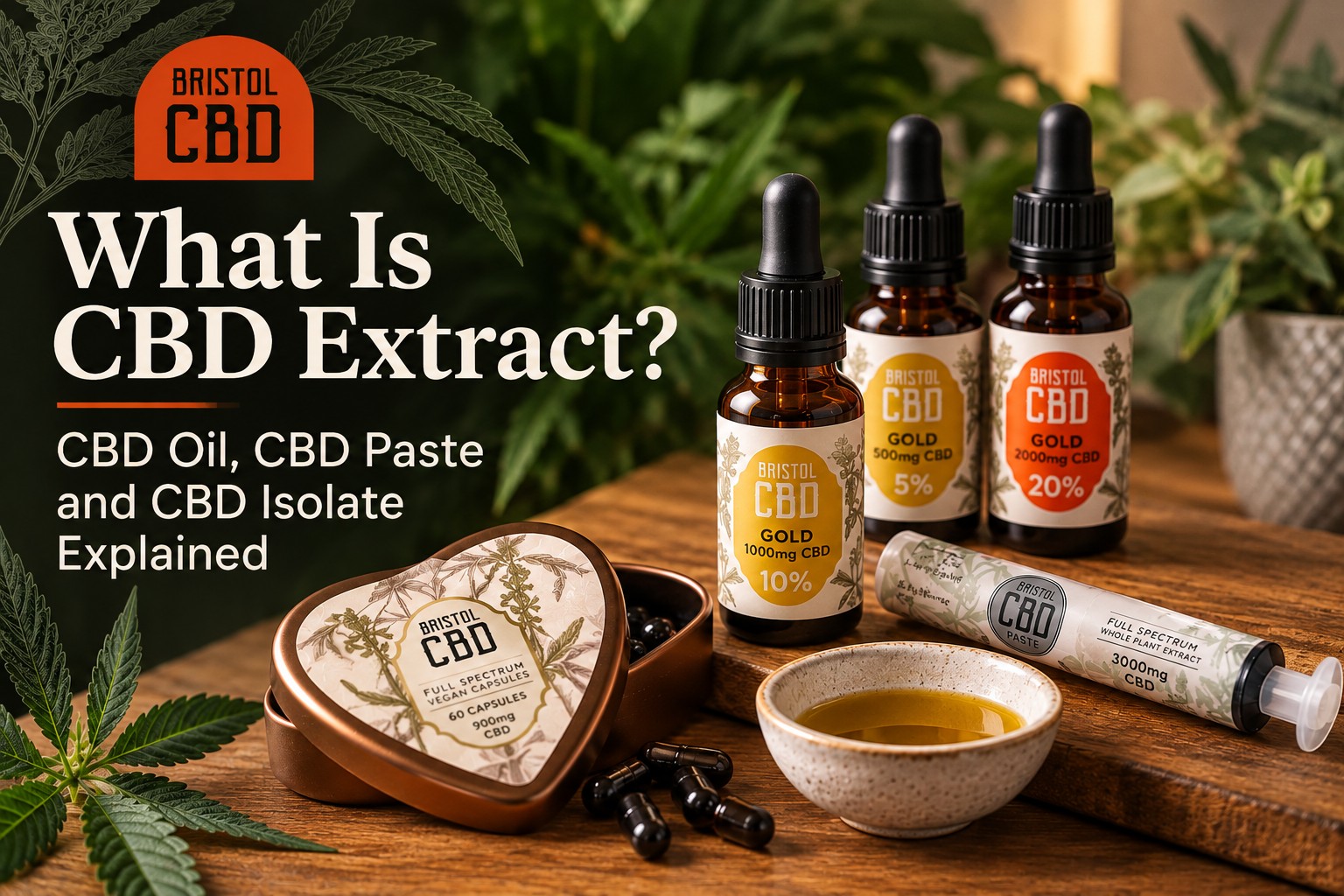
At Bristol CBD, for example, our 10% Whole Plant Full Spectrum CBD Oil is made using whole-plant hemp extract suspended in organic hemp seed oil. Our extract is produced using supercritical CO2 extraction, which allows other naturally occurring compounds from the hemp plant to be retained alongside CBD.
You can see our range and buy CBD oil here:
The carrier oil makes a concentrated CBD extract easier to measure and use. Different manufacturers may use different carrier oils and different forms of CBD extract, which is one reason two CBD oils displaying a similar CBD percentage can be quite different products.
When choosing CBD oil, it is therefore worth looking beyond the number printed on the front of the bottle. Consider the type of CBD extract, whether the product is full spectrum or broad spectrum, the total amount of CBD, bottle size, ingredients and available laboratory testing.
What Is Full Spectrum CBD?
Full spectrum CBD is produced with the intention of retaining a broad range of compounds naturally present in hemp rather than isolating CBD on its own.
Depending on the product and extract, these compounds can include CBD alongside other cannabinoids, terpenes and flavonoids.
Terpenes are naturally occurring aromatic compounds found in many plants. Cannabinoids are a family of compounds that includes CBD, while flavonoids are plant compounds found throughout the natural world.
The combination of these different components is commonly discussed in relation to what is known as the “entourage effect”. This is the theory that different components of the plant may interact when consumed together rather than CBD always acting in isolation. Research into these interactions continues, so the entourage effect should not be interpreted as a guarantee that a full spectrum product will produce a particular health outcome.
At Bristol CBD, whole-plant full spectrum products form an important part of our range. Our 10% Whole Plant Full Spectrum CBD Oil, for example, contains whole-plant hemp extract suspended in organic hemp seed oil. A 10ml bottle contains 1,000mg of CBD, while the 20ml version contains 2,000mg.
You can view our 10% Whole Plant CBD Oil here:
You can also browse our full spectrum CBD products here:
https://www.bristolcbd.co.uk/product-tag/full-spectrum
What Is Broad Spectrum CBD?
Broad spectrum CBD sits somewhere between full spectrum CBD and CBD isolate.
Like a full spectrum extract, broad spectrum CBD can contain a range of cannabinoids and other plant compounds. However, it undergoes additional processing to remove THC from the finished formulation.
This can make broad spectrum CBD an option for people who want a CBD oil containing more than CBD alone but would prefer a formulation without THC.
It is important to understand that “broad spectrum” does not mean weaker or stronger than “full spectrum”. These terms describe the composition of the extract rather than its CBD concentration.
A 10% broad spectrum CBD oil and a 10% full spectrum CBD oil can therefore contain the same concentration of CBD while having different cannabinoid profiles.
You can see Bristol CBD’s 10% Broad Spectrum CBD Oil here:
What Is CBD Isolate?
CBD isolate is a highly purified form of cannabidiol.
Rather than retaining the wider range of cannabinoids and plant compounds found in full spectrum CBD extract, the extraction and refinement process removes these other components to leave CBD in a highly concentrated form.
CBD isolate is often supplied as a crystalline powder and can be used as an ingredient in CBD formulations.
The important distinction is that isolate is about purity and composition. It should not automatically be confused with high-strength CBD oil.
An oil made with CBD isolate could contain a relatively low concentration of CBD, while a full spectrum product could contain a much higher concentration. You therefore need to look at both the type of extract and the amount of CBD in the finished product.
The Food Standards Agency has assessed a number of novel food applications involving high-purity CBD isolates. Its published assessments describe CBD isolates containing approximately 97% to 98% or more CBD, illustrating just how concentrated the raw isolate ingredient can be.
What Is CBD Paste?
CBD paste is another concentrated form of CBD product.
While CBD oils are formulated as liquids that can be measured using a dropper or spray, CBD paste has a much thicker consistency and is normally supplied in a syringe-style applicator.
This makes CBD paste particularly relevant when looking for high-strength CBD products.
A paste can contain a high concentration of CBD without requiring the same volume of carrier oil that you would find in a conventional CBD oil. Depending on the product, it may also retain other components of the hemp extract.
For example, Bristol CBD’s 23% CBD and CBG Paste contains 2,300mg of CBD in a 10g syringe and combines CBD with CBG.
You can see the 23% CBD and CBG Paste here:
CBD paste and CBD oil therefore offer different ways of using a CBD extract. Neither format is automatically “better”. The more appropriate choice depends on factors such as the concentration you want, how you prefer to use your CBD and how easily you want to measure it.
CBD Oil vs CBD Paste: What Is the Difference?
The easiest way to understand the difference between CBD oil and CBD paste is to think about concentration and consistency.
CBD oil is liquid because CBD extract is combined with a carrier oil. This makes it convenient to measure using a dropper or spray and allows manufacturers to produce a wide range of concentrations.
CBD paste is thicker and can contain a more concentrated hemp extract. It is generally supplied in a syringe so that a small amount can be dispensed at a time.
For people comparing standard CBD oil with high-strength CBD oil or paste, the most useful figures to examine are the percentage strength, total CBD in milligrams and size of the container.
These figures tell you much more than the product name alone.
What Does the Percentage on CBD Oil Mean?
CBD percentages are one of the areas that cause the most confusion.
The percentage describes the concentration of CBD in the product. The milligram figure tells you the total amount of CBD contained in the bottle.
This distinction becomes particularly important when comparing different bottle sizes.
For example, Bristol CBD’s 10% Whole Plant Full Spectrum CBD Oil is available as a 10ml dropper bottle containing 1,000mg of CBD and a 20ml spray bottle containing 2,000mg.
Both products are still 10% CBD oil. The larger bottle contains twice the volume and therefore twice the total quantity of CBD, but the concentration remains 10%.
The same principle applies when comparing other CBD oils. A larger milligram figure does not necessarily mean that the liquid itself is stronger. You need to consider the amount of CBD in relation to the total product volume.
What Is High-Strength CBD Oil?
There is no single universal percentage at which a product suddenly becomes “high-strength CBD oil”. The term is generally used commercially to distinguish more concentrated oils from lower-percentage alternatives.
This is why looking at the actual percentage and milligram content is more useful than relying on descriptions such as “strong” or “extra strong”.
A higher-strength CBD oil contains more CBD within a given volume of oil. This means a smaller volume can provide the same quantity of CBD as a larger volume of a weaker oil.
However, stronger does not automatically mean better.
Someone new to CBD may prefer a product that makes smaller quantities of CBD easier to measure. Someone who already knows the concentration and format they prefer may find a more concentrated product more convenient.
The key is understanding exactly what you are buying rather than simply choosing the highest percentage available.
Full Spectrum CBD vs CBD Isolate
The main difference between full spectrum CBD and CBD isolate is the range of compounds contained in the product.
CBD isolate is highly purified cannabidiol. Full spectrum CBD extract retains CBD alongside a broader profile of naturally occurring hemp compounds.
This difference is important because it changes the overall composition of the product, even when two products contain an identical quantity of CBD.
People interested in a whole-plant approach may prefer full spectrum CBD. Others may specifically want a formulation based on CBD isolate. Neither term tells you everything about product quality, however.
The source of the ingredients, manufacturing standards, laboratory testing, CBD concentration and regulatory status should all be considered when choosing a CBD product.
Full Spectrum CBD vs Broad Spectrum CBD
Full spectrum and broad spectrum products have more in common with each other than either has with a pure CBD isolate, but there is an important distinction.
Full spectrum CBD retains a broad profile of hemp compounds, including legally controlled trace components where permitted within the finished product. Broad spectrum products undergo additional refinement to remove THC while retaining CBD and other selected plant compounds.
For some customers, that difference is central to their buying decision.
If you are unsure which type you are looking at, do not rely solely on marketing descriptions. Read the ingredients and product information and check whether independent laboratory results are available.
Does CBD Extract Get You High?
CBD itself is not the cannabinoid primarily associated with the intoxicating “high” caused by cannabis. That effect is principally associated with THC.
This is one reason understanding the type of CBD extract matters.
Full spectrum, broad spectrum and isolate products have different cannabinoid profiles. UK CBD products must also comply with the relevant legal and regulatory requirements.
Consumers should nevertheless avoid assuming that every product labelled “CBD” has the same composition. Buying from a transparent supplier that provides clear product information and appropriate laboratory testing gives you considerably more information about what is actually in the product.
How Is CBD Extract Made?
There are several ways of extracting cannabinoids from hemp, and the extraction method can influence the resulting product.
At Bristol CBD, our Whole Plant CBD Oil uses hemp extract produced through supercritical CO2 extraction. This method uses carbon dioxide under controlled temperature and pressure conditions to extract compounds from plant material.
The resulting extract can then be processed according to the type of finished product being produced. For a whole-plant full spectrum oil, the aim is to retain a wider spectrum of naturally occurring components. Producing isolate requires considerably more refinement because other compounds need to be removed to leave highly purified CBD.
The finished CBD extract can subsequently be formulated into CBD oil, paste or other CBD products.
Is CBD Extract the Same as Hemp Seed Oil?
No. This is an important distinction.
CBD extract and hemp seed oil come from the same broad family of plants, but they are not interchangeable ingredients.
Hemp seed oil is produced from hemp seeds and is commonly used as a food and carrier oil. CBD extract is produced from cannabinoid-containing parts of the hemp plant.
A CBD oil may contain both. In Bristol CBD’s 10% Whole Plant CBD Oil, for example, whole-plant hemp extract is suspended in organic hemp seed oil.
The hemp seed oil acts as the carrier, while the hemp extract provides the CBD and other compounds associated with the extract.
If you see a bottle of plain hemp seed oil, therefore, you should not assume that it contains CBD. Look for a clearly stated CBD content in milligrams and check the ingredients.
How Do You Choose Between CBD Oil, CBD Paste and CBD Isolate?
The best starting point is to consider what you actually want from the format rather than immediately looking for the strongest product.
CBD oil is a popular and convenient format because it is straightforward to measure and is available in different concentrations. It is also possible to choose between full spectrum, broad spectrum and other formulations.
CBD paste offers a much thicker and often highly concentrated alternative. It can suit people who specifically want a concentrated product and are comfortable using a syringe-style dispenser.
CBD isolate is different again. It is a highly purified CBD ingredient without the wider cannabinoid and plant profile associated with full spectrum CBD.
Your choice should therefore take into account the product format, CBD concentration, total CBD content and cannabinoid profile.
What Should You Look for When Buying CBD Oil?
Good CBD oil should make it easy for you to understand what you are buying.
Look for a clearly stated CBD concentration and total milligram content. Check the bottle size so that you can make a meaningful comparison between products. Find out whether the oil is full spectrum, broad spectrum or made using isolate, and look at the other ingredients used in the formulation.
Laboratory information is also important because it provides additional transparency about the product’s composition.
Regulatory status matters too. In England and Wales, the Food Standards Agency maintains a register of CBD food products linked to novel food applications. The FSA explains that inclusion on this list does not mean that a product is formally authorised or endorsed by the agency; rather, listed products are linked to applications that meet its stated criteria and are progressing through the novel food process.
CBD Safety and Current UK Guidance
CBD is widely available in the UK, but it is still important to approach it sensibly.
The Food Standards Agency currently advises healthy adults to limit CBD from food products to 10mg per day. This is precautionary guidance based on the available evidence and uncertainties surrounding long-term use.
The FSA also advises that CBD is not recommended for children, people who are pregnant or breastfeeding, people trying for a baby and people who are immunosuppressed unless under medical direction. People taking medication should seek medical advice before using CBD because interactions may be possible.
Guidance can change as new evidence becomes available, so it is worth checking the latest information directly with the Food Standards Agency rather than relying on old articles or social media posts.
Which CBD Extract Is Right for You?
Once you understand the terminology, choosing a CBD product becomes much easier.
CBD extract is the foundation from which many CBD products are produced. CBD oil takes an extract and incorporates it into a liquid formulation, usually with a carrier oil. CBD paste provides a thicker and potentially more concentrated format. CBD isolate takes a different approach by refining CBD to a very high degree of purity.
Full spectrum CBD retains a broader range of hemp compounds, while broad spectrum CBD provides CBD alongside other selected compounds but with THC removed from the formulation.
If you are comparing CBD oils, particularly high-strength CBD oil, remember to look at both the percentage and the total number of milligrams. A bigger milligram number may simply mean a bigger bottle rather than a stronger concentration.
Most importantly, choose CBD products from a company that tells you clearly what is in the product, how much CBD it contains and how it has been produced.
If you need help understanding the difference between our CBD oils, pastes and different strengths, please get in touch with Bristol CBD. We’re always happy to explain the options in simple language and help you understand what you are buying.
You can browse and buy CBD oil here:
💚 About Bristol CBD
Bristol CBD is the most trusted CBD brand in the UK, with a 5 star rating on both Google and Trustpilot. Alongside our premium CBD products, we also offer a carefully curated range of high-spec functional mushrooms, including Lion’s Mane, Shiitake, Chaga and Reishi
At Bristol CBD we are committed to providing high quality, affordable CBD products together with friendly customer support. Bristol CBD is one of the few companies in the UK that has achieved full validation on the Food Standards Agency’s novel foods list for CBD products.
We pride ourselves on offering unparalleled customer service, support, and advice, backed by a 100% money-back guarantee if you’re not completely satisfied with your product.
If you have any questions about buying or using CBD or medicinal mushrooms, feel free to call us anytime on 07706 031 935. We’re always happy to share our experience and help you find the best solution for your personal needs.
Please note: our staff are not qualified doctors or nurses, and we do not make medical claims or recommend CBD for specific ailments. All content is based on scientific research and years of practical experience. We always encourage speaking with your GP or healthcare provider before starting any new supplement.