





When choosing a CBD oil, most people naturally focus on the strength, the amount of CBD in the bottle and whether the product is full spectrum or broad spectrum. However, there’s another ingredient worth understanding: the CBD carrier oil.
Carrier oils play an important role in how CBD products are formulated, how they taste and how easy they are to use. Whether you’re looking at CBD oil with MCT, hemp seed oil CBD products or olive oil CBD formulations, the carrier oil can make a noticeable difference to your experience.
But which carrier oil is best? Does MCT oil make CBD more effective? Is hemp seed oil a more natural choice? And why do some manufacturers prefer olive oil?
At Bristol CBD, we believe understanding what goes into your CBD oil is just as important as knowing how much CBD it contains. In this guide, we’ll explore the differences between MCT, hemp seed and olive oil, explain why manufacturers use them and help you make a more informed decision when choosing a CBD product.
What Is a CBD Carrier Oil?
A CBD carrier oil is the oil used to dilute and carry a concentrated CBD extract in a finished product.
CBD, or cannabidiol, is a naturally occurring compound found in the hemp plant. It is fat-soluble, meaning it dissolves in fats and oils rather than water.
During CBD production, cannabinoids are extracted from hemp and may then be blended with a carrier oil to achieve the intended concentration.
For example, a manufacturer might combine a CBD-rich extract with hemp seed oil to create a 5% or 10% CBD product. The carrier oil helps distribute the extract throughout the bottle and makes it easier to measure smaller amounts using a pipette.
Without a carrier oil, concentrated hemp extracts can be thick, sticky and difficult to measure accurately.
Carrier oils also influence the flavour, texture, fatty acid composition and storage characteristics of the finished CBD oil.
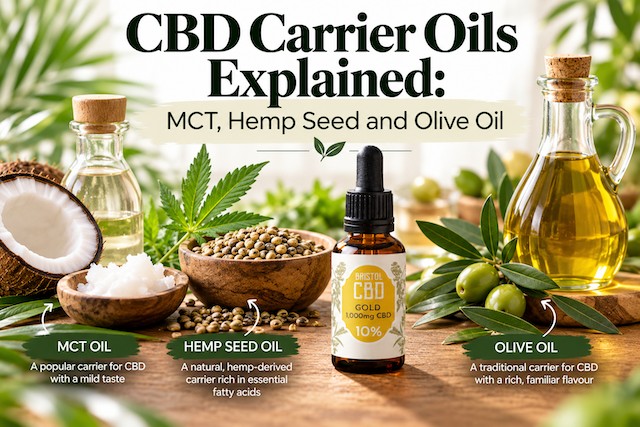
The three carrier oils most commonly discussed are MCT oil, hemp seed oil and olive oil.
Each has different properties, and understanding these differences can help you choose a product that suits your preferences.
Why Does CBD Need a Carrier Oil?
The main purpose of a carrier oil is to create a practical, consistent CBD formulation.
CBD extracts are often highly concentrated. Blending them with a suitable carrier oil allows manufacturers to produce different strengths while keeping the product easy to use.
A carrier oil also provides a fat-based environment in which CBD can dissolve.
This is particularly relevant because cannabinoids are lipophilic, meaning they have an affinity for fats.
However, it’s important to distinguish between helping CBD dissolve in a product and proving that a particular carrier oil produces better absorption in the human body.
Although researchers have investigated lipid-based cannabinoid formulations, the evidence doesn’t establish that one everyday CBD carrier oil is universally superior for every person.
The quality of the CBD extract, formulation, amount consumed and whether CBD is taken with food can all influence the experience.
A good carrier oil is therefore one part of a well-formulated product, rather than a guarantee of stronger effects.
MCT Oil: A Popular Carrier for CBD
MCT stands for medium-chain triglycerides, a type of fat made up of medium-chain fatty acids.
MCT oil is commonly produced from coconut oil, although the two products are not identical.
Coconut oil naturally contains a mixture of fats, whereas commercial MCT oil is typically processed to concentrate particular medium-chain triglycerides, often those containing caprylic acid (C8) and capric acid (C10).
MCT oil has become a popular ingredient in CBD products because it has a relatively light texture, a mild flavour and good suitability for oil-based formulations.
Why Is MCT Oil Used in CBD Products?
One of the main advantages of MCT oil is its neutral taste.
Some CBD extracts have a naturally earthy, grassy or bitter flavour. When blended with MCT oil, the finished product may taste milder than a comparable formulation using a strongly flavoured carrier.
This can appeal to people who prefer CBD drops without a pronounced hemp seed oil flavour.
MCT oil also remains liquid at normal room temperatures and is generally easy to dispense using a pipette.
Another reason manufacturers use MCT oil is its relatively good oxidative stability compared with oils containing higher proportions of polyunsaturated fats.
This doesn’t mean that CBD oil with MCT lasts indefinitely. The stability of the finished product still depends on its complete formulation, packaging and storage conditions.
Does MCT Oil Improve CBD Absorption?
You’ll often see claims that CBD oil with MCT is absorbed faster or more efficiently than CBD formulated with other carrier oils.
There is a scientific basis for studying MCTs in drug and nutrient delivery, because medium-chain fats are digested and metabolised differently from many long-chain fats.
However, this doesn’t automatically prove that ordinary CBD drops containing MCT deliver more CBD into the bloodstream than products containing hemp seed or olive oil.
CBD absorption is complicated. It depends on factors such as the formulation, dose, digestive conditions and whether food is present.
Research has shown that consuming CBD with a high-fat meal can substantially increase systemic exposure compared with taking it while fasting. That finding is important, but it shouldn’t be interpreted as proof that MCT is the best carrier oil.
For most customers, taste, ingredient preferences, product quality and clearly labelled CBD content are more practical considerations.
What Does MCT-Based CBD Oil Taste Like?
MCT oil itself is generally mild and relatively neutral.
The flavour of the finished CBD product will therefore depend largely on the type and amount of hemp extract used.
A CBD isolate formulation may taste quite different from a whole plant extract containing additional naturally occurring hemp compounds.
If you dislike the characteristic taste of hemp seed oil, an MCT-based product may be worth considering.
Hemp Seed Oil: A Natural Partner for CBD
Hemp seed oil is another widely used CBD carrier oil, particularly in whole plant CBD formulations.
It is produced by pressing the seeds of the hemp plant, usually Cannabis sativa.
An important distinction is that hemp seed oil and CBD oil are not the same thing.
Hemp seeds do not naturally contain meaningful quantities of CBD in the way that the resin-producing parts of the hemp plant do. Hemp seed oil is therefore not automatically a CBD product.
A bottle labelled simply as hemp seed oil may contain little or no CBD unless cannabidiol has been added or the product has been formulated using a CBD-containing hemp extract.
This distinction matters when comparing products online, where the terms hemp oil, CBD oil and hemp seed oil are sometimes used inconsistently.
Why Use Hemp Seed Oil as a CBD Carrier Oil?
Hemp seed oil is a natural choice for manufacturers who want to create a CBD product based primarily on ingredients from the hemp plant.
It contains a mixture of fatty acids, including linoleic acid, an omega-6 fatty acid, and alpha-linolenic acid, an omega-3 fatty acid.
These essential fatty acids are important components of the human diet because the body cannot manufacture them in sufficient quantities.
Hemp seed oil also contains other naturally occurring plant constituents, with the exact composition depending on the seeds and processing methods.
However, it’s important to keep the nutritional contribution of CBD drops in perspective.
A few drops of hemp seed oil provide only a small quantity of dietary fat. They shouldn’t be regarded as a replacement for normal dietary sources of essential fatty acids.
What Does Hemp Seed Oil CBD Taste Like?
Hemp seed oil usually has a distinctive nutty, earthy or slightly grassy flavour.
Some people enjoy this natural taste, particularly when combined with a whole plant hemp extract.
Others prefer the milder flavour of MCT oil.
Taste is largely a matter of personal preference, and a stronger hemp flavour doesn’t necessarily mean that a product contains more CBD or is better quality.
The concentration and composition of the hemp extract can have a substantial influence on the flavour.
Is Hemp Seed Oil Better for Whole Plant CBD?
Hemp seed oil is often associated with whole plant CBD products because both ingredients originate from hemp.
This makes it an appealing formulation choice for customers who prefer a hemp-based product.
However, the phrase whole plant generally refers to the composition or origin of the hemp extract, rather than the carrier oil alone.
A product containing CBD isolate blended with hemp seed oil is not automatically equivalent to a whole plant CBD extract.
Similarly, a whole plant CBD extract can potentially be formulated using a different suitable carrier oil.
When comparing products, it’s worth looking beyond the front label to understand what type of CBD extract is used and which ingredients are included.
At Bristol CBD, our 5% Whole Plant CBD Oil and 10% Whole Plant CBD Oil are useful starting points for exploring different CBD strengths. Always check the individual product’s ingredient information to confirm its carrier oil and formulation.
Olive Oil: A Traditional Carrier Oil for CBD
Olive oil has a long history of use in food preparation and is also used as a carrier in some herbal and cannabinoid preparations.
It contains a high proportion of monounsaturated fats, particularly oleic acid, alongside smaller amounts of other fatty acids.
Olive oil is familiar to most people, widely available and generally well understood as a food ingredient.
These characteristics make it another practical option for CBD formulations.
Why Do Some CBD Manufacturers Use Olive Oil?
Olive oil can dissolve lipid-soluble hemp compounds and provides a suitable base for certain CBD products.
Its fatty acid composition and natural antioxidant constituents can contribute to the characteristics of the finished oil.
Olive oil is also familiar to customers who prefer traditional food-based ingredients.
However, the properties of olive oil vary depending on whether it is extra virgin, refined or produced using other methods.
The finished CBD product will also depend on the type of extract added and how the formulation is manufactured.
What Does Olive Oil CBD Taste Like?
Olive oil generally has a more noticeable flavour than MCT oil.
Depending on the olive variety and processing method, it may taste fruity, grassy, peppery or slightly bitter.
These flavours can combine with the natural taste of hemp extract.
Some customers enjoy this combination, while others may find it stronger than expected.
If flavour is particularly important to you, it’s worth considering the carrier oil alongside the CBD extract itself.
Does Olive Oil Make CBD More Effective?
There isn’t enough reliable comparative human evidence to conclude that olive oil makes ordinary CBD supplements consistently more effective than MCT or hemp seed oil.
Olive oil can act as a suitable carrier, but claims about superior absorption or health benefits should be treated cautiously unless supported by evidence relating to the actual formulation.
It’s also important not to confuse the established nutritional role of olive oil in a balanced diet with the effects of consuming the very small quantities typically present in CBD drops.
CBD Carrier Oil Comparison: MCT vs Hemp Seed vs Olive Oil
Although all three oils can be used to carry CBD, they have noticeably different characteristics.
| Feature | MCT Oil | Hemp Seed Oil | Olive Oil |
|---|---|---|---|
| Main source | Usually coconut-derived | Hemp seeds | Olives |
| Typical flavour | Mild and neutral | Nutty and earthy | Fruity or peppery |
| Fat composition | Medium-chain triglycerides | Rich in polyunsaturated fats | Rich in monounsaturated fats |
| Texture | Light | Light to medium | Medium |
| Oxidative stability | Generally good | More sensitive to oxidation | Generally good |
| CBD formulation use | Common | Common | Used in some products |
| Main attraction | Mild taste and convenience | Hemp-based ingredients | Familiar food ingredient |
No single carrier oil is necessarily the best option for everyone.
If you prefer a mild flavour, MCT oil may appeal to you.
If you like hemp-derived ingredients and don’t mind a nutty taste, hemp seed oil may be more attractive.
If you prefer a familiar, traditional oil, olive oil may suit your preferences.
The more important question is whether the finished CBD product is well made, accurately labelled and appropriate for your needs.
Is Hemp Seed Oil the Same as Cold-Pressed CBD Oil?
This is an important distinction because the terminology can be confusing.
Hemp seed oil is typically made by pressing hemp seeds.
Cold-pressed CBD oil, depending on the product and manufacturing method, refers to a CBD-containing oil produced using a process described as cold pressing.
These terms shouldn’t automatically be treated as interchangeable.
A cold-pressed hemp seed oil does not necessarily contain meaningful amounts of CBD.
Likewise, a CBD product described as cold pressed should be assessed according to its actual ingredients, manufacturing information and laboratory analysis.
At Bristol CBD, we’ve explored this subject in more detail in our guide, Cold-Pressed CBD Oil: What Are the Benefits?.
If you’re interested in this type of product, you can also explore our High-Terpene Cold-Pressed 10% CBD Oil.
When choosing a cold-pressed CBD product, it’s worth understanding both the extraction method and the composition of the finished oil rather than relying on the phrase cold pressed alone.
Does the Carrier Oil Affect the Strength of CBD?
The carrier oil itself doesn’t determine the strength of a CBD product.
CBD strength is normally expressed as a percentage or as a total quantity of CBD in milligrams.
For example, a 10ml bottle labelled 5% CBD commonly contains approximately 500mg of CBD, while a comparable 10ml bottle labelled 10% CBD commonly contains approximately 1,000mg.
These figures describe the CBD concentration, not the type of carrier oil.
A 10% CBD oil formulated with MCT isn’t automatically stronger than a 10% CBD oil formulated with hemp seed oil.
However, differences in formulation, extract composition and absorption can influence how products behave.
It’s also worth remembering that the number of drops per millilitre can vary depending on the pipette and oil characteristics.
For accurate comparisons, use the labelled CBD content in milligrams rather than relying solely on the number of drops.
Does the Carrier Oil Affect CBD Absorption?
CBD has relatively low and variable oral bioavailability, meaning that only a proportion of the swallowed CBD reaches the bloodstream unchanged.
One reason is that CBD is poorly soluble in water. Another is that CBD undergoes metabolism as it passes through the digestive system and liver.
Lipid-based formulations can influence how cannabinoids are dispersed and absorbed, which is why carrier oils are an important area of formulation research.
However, absorption depends on more than the identity of the carrier oil.
The size and composition of oil droplets, the presence of other ingredients, the amount consumed and whether CBD is taken with food can all make a difference.
Research involving pharmaceutical CBD preparations has demonstrated a significant food effect, with high-fat meals increasing CBD exposure compared with fasting.
This provides useful scientific context, but the results shouldn’t be used to claim that a particular retail CBD oil has a guaranteed absorption advantage.
For customers, consistency is generally more useful than trying to identify a universally superior carrier oil.
Are CBD Carrier Oils Suitable for Vegans?
MCT oil, hemp seed oil and olive oil are all plant-derived when produced from the sources described above.
That means they can be suitable ingredients for vegan CBD products.
However, the carrier oil alone doesn’t establish whether the entire finished product is vegan.
Other ingredients, processing aids and capsule materials may also need to be considered.
If vegan suitability is important to you, check the complete product information rather than assuming that every CBD oil is automatically vegan.
Can You Be Allergic or Sensitive to a CBD Carrier Oil?
Although these carrier oils are widely used, individual sensitivities can occur.
MCT oil may be derived from coconut, which is relevant for customers who need to investigate ingredient sources because of allergies or sensitivities.
Hemp seed oil and olive oil can also be unsuitable for some individuals.
In addition, some people experience digestive discomfort when consuming MCT oil, particularly in larger quantities.
If you have a known food allergy, ask the manufacturer about the precise ingredients and manufacturing process before using a product.
Anyone who experiences an unexpected reaction should stop using the product and seek appropriate medical advice.
Does Carrier Oil Affect the Shelf Life of CBD Oil?
Yes, the carrier oil can influence the stability of the finished product.
Oils containing higher proportions of polyunsaturated fatty acids, such as hemp seed oil, are generally more susceptible to oxidation than more saturated oils.
MCT oil is often valued for its relative oxidative stability.
Olive oil also has useful stability characteristics, although these depend on its composition and processing.
However, the shelf life of a CBD product cannot be determined from its carrier oil alone.
The hemp extract, other ingredients, manufacturing conditions, packaging and storage environment all play a role.
CBD oils are generally best stored tightly closed, away from excessive heat, direct sunlight and moisture, in accordance with the manufacturer’s instructions.
Always check the best-before date and any storage guidance provided with the product.
What Should You Look for When Buying CBD Oil?
Understanding carrier oils is useful, but it should be part of a wider assessment of product quality.
A trustworthy CBD product should clearly identify its CBD content, ingredients and recommended use.
Independent laboratory testing is particularly valuable because it can help verify cannabinoid content and screen for relevant contaminants.
It’s also worth understanding the difference between CBD isolate, broad-spectrum and full-spectrum extracts, as these terms describe the cannabinoid composition rather than simply the carrier oil.
The origin of the hemp, the manufacturing process and the transparency of the company are also worth considering.
For UK customers, regulatory compliance is another important factor.
The Food Standards Agency maintains a public list of CBD food products associated with novel food applications. However, appearing on this list, or having a validated application, is not the same as receiving full novel food authorisation.
You can learn more through the official Food Standards Agency guidance on cannabidiol (CBD).
The FSA currently advises healthy adults to limit CBD from food supplements to 10mg per day as a precaution. It also advises against CBD consumption by children, people who are pregnant or breastfeeding, and people taking medication unless advised otherwise by a healthcare professional.
These precautions apply regardless of whether the CBD is carried in MCT, hemp seed or olive oil.
Frequently Asked Questions About CBD Carrier Oils
What is the best carrier oil for CBD?
There is no single best carrier oil for everyone. MCT oil is popular for its mild taste, hemp seed oil appeals to people who prefer hemp-derived ingredients, and olive oil offers a familiar food-based alternative. Product quality and accurate CBD labelling are more important than choosing a carrier based on marketing claims.
Is CBD oil with MCT better than hemp seed oil CBD?
Not necessarily. Both can be suitable carriers for CBD. Although MCT and hemp seed oil have different fatty acid compositions and flavours, there isn’t sufficient comparative human evidence to establish that one is consistently more effective in ordinary CBD products.
Does hemp seed oil contain CBD naturally?
Hemp seed oil made from properly cleaned hemp seeds generally contains little or no CBD. Meaningful CBD content normally comes from CBD-rich hemp extracts added during formulation. Always check the label for the actual CBD content.
Is olive oil a good CBD carrier oil?
Olive oil can be used as a suitable carrier for CBD. It contains predominantly monounsaturated fats and has a familiar flavour, although it can taste stronger than MCT oil.
Does MCT oil make CBD work faster?
There isn’t enough evidence to guarantee that ordinary CBD oil containing MCT acts faster than comparable products containing other carrier oils. Absorption depends on the overall formulation, individual circumstances and whether CBD is consumed with food.
Can I change the carrier oil in my CBD drops?
It’s generally better not to modify a finished CBD product. Adding another oil changes the concentration and may make accurate measuring more difficult. If you prefer a different carrier oil, choose a properly formulated product that already uses it.
Is hemp seed oil CBD the same as full-spectrum CBD?
No. Hemp seed oil describes the carrier ingredient, while full-spectrum describes the composition of the hemp extract. A full-spectrum CBD product may contain additional naturally occurring cannabinoids and other hemp constituents, subject to its formulation and applicable legal requirements.
Which CBD carrier oil has the mildest taste?
MCT oil is generally the mildest of the three. Hemp seed oil has a more distinctive nutty flavour, while olive oil can taste fruity or peppery. The hemp extract itself can also strongly influence the finished flavour.
Final Thoughts: Choosing the Right CBD Carrier Oil
The CBD carrier oil may not be the first thing you notice when buying CBD drops, but it’s an important part of the finished product.
MCT, hemp seed and olive oil each offer different characteristics. MCT is valued for its mild flavour and light texture, hemp seed oil provides a natural hemp-derived base, and olive oil offers a familiar alternative with its own distinctive composition.
When comparing CBD oil MCT, hemp seed oil CBD and olive oil CBD formulations, it’s worth remembering that no carrier oil can guarantee better results for everyone.
A carefully formulated CBD product should combine suitable ingredients with transparent labelling, reliable testing and clear information about CBD content.
If you’re exploring CBD oils, take a look at our 5% Whole Plant CBD Oil and 10% Whole Plant CBD Oil, or learn more about our High-Terpene Cold-Pressed CBD Oil.
And if you’re unsure which product or formulation is right for you, we’re always happy to explain the differences and help you make an informed choice.
💚 About Bristol CBD
Bristol CBD is the most trusted CBD brand in the UK, with a 5 star rating on both Google and Trustpilot. Alongside our premium CBD products, we also offer a carefully curated range of high-spec functional mushrooms, including Lion’s Mane, Shiitake, Chaga and Reishi
At Bristol CBD we are committed to providing high quality, affordable CBD products together with friendly customer support. Bristol CBD is one of the few companies in the UK that has achieved full validation on the Food Standards Agency’s novel foods list for CBD products.
We pride ourselves on offering unparalleled customer service, support, and advice, backed by a 100% money-back guarantee if you’re not completely satisfied with your product.
If you have any questions about buying or using CBD or medicinal mushrooms, feel free to call us anytime on 07706 031 935. We’re always happy to share our experience and help you find the best solution for your personal needs.
Please note: our staff are not qualified doctors or nurses, and we do not make medical claims or recommend CBD for specific ailments. All content is based on scientific research and years of practical experience. We always encourage speaking with your GP or healthcare provider before starting any new supplement.