






If you have started looking at stronger CBD products, you may have noticed that there is a surprisingly wide choice. You will find CBD oils at different percentages, products described as high strength CBD oil or strong CBD oil, and concentrated CBD pastes containing considerably more CBD.
So, how do you know which one is right for you?
The important thing to understand is that CBD strength and CBD format are two separate considerations. A stronger product contains more CBD within the same quantity of oil or paste, but that does not automatically make it the right choice for everyone.
For some people, a 10% CBD oil provides a straightforward way to measure and control their CBD intake. Others may prefer a more concentrated 20% oil. CBD paste offers another option for people who prefer a highly concentrated whole-plant product.
In this guide, we will explain CBD oil strengths, what percentages and milligrams actually mean, how CBD oil compares with CBD paste, and what to consider when choosing between them.
What Do CBD Oil Strengths Actually Mean?
One of the most confusing parts of buying CBD for the first time is understanding the numbers on the bottle.
CBD products are commonly labelled using either a percentage, a quantity in milligrams, or both.
The percentage tells you the concentration of CBD within the product. The milligram figure tells you the total amount of CBD contained within the bottle.
For example, a 10ml bottle containing 10% CBD contains approximately 1,000mg of CBD in total. A 10ml bottle containing 20% CBD contains approximately 2,000mg.
This means that 20% CBD oil is twice as concentrated as 10% CBD oil.
That distinction matters because buying a stronger oil does not necessarily mean you intend to consume more CBD. A higher concentration simply means you receive more CBD from a smaller quantity of oil.
Understanding this is one of the easiest ways to make sense of the different CBD products available.
If you would like to explore this subject in more detail, read our CBD oil strength guide.
What Does CBD 1000mg Mean?
Another common search we see is CBD 1000mg UK, and it is easy to understand why there can be confusion around this term.
The number 1,000mg refers to the total quantity of CBD in the product rather than necessarily telling you its concentration.
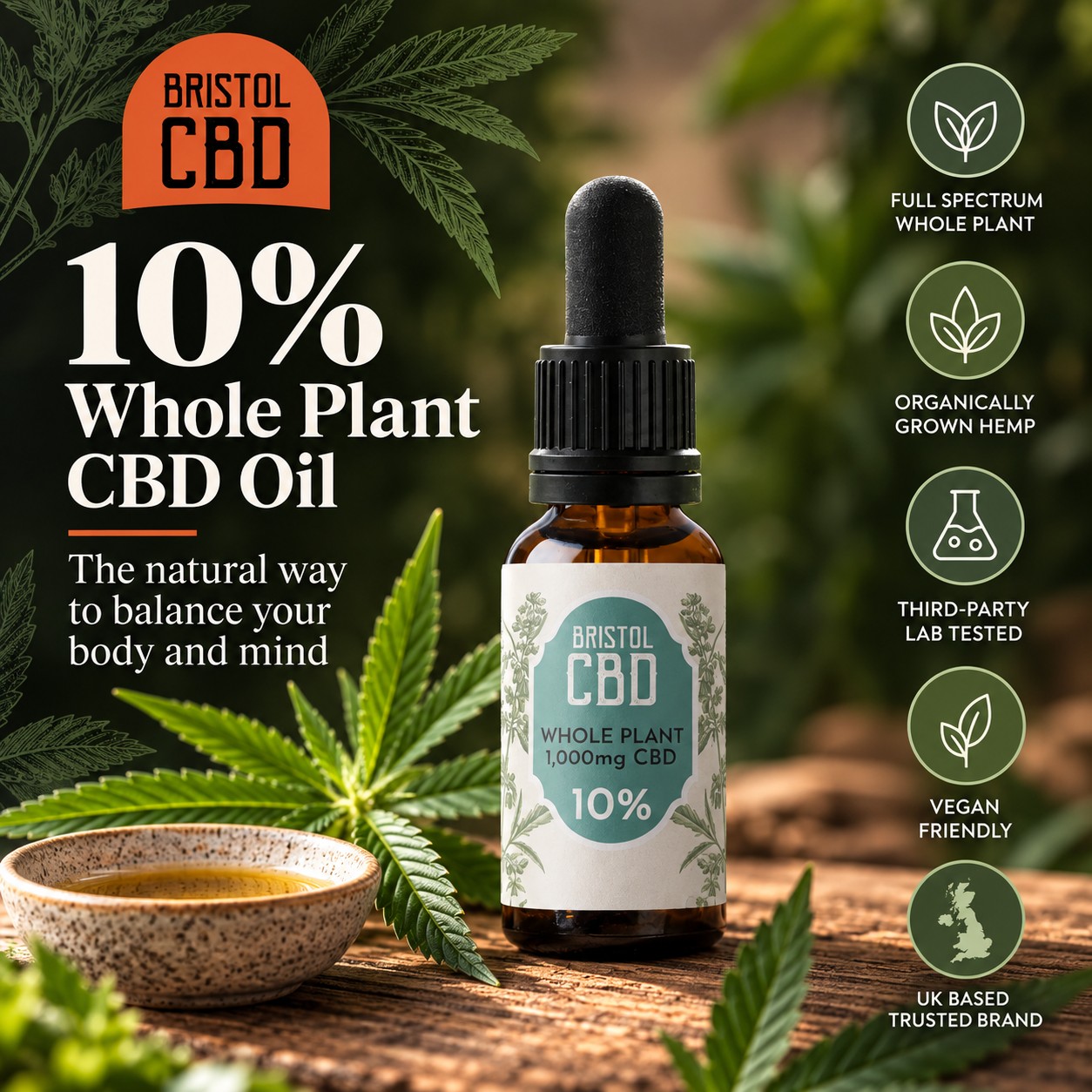
For example, Bristol CBD’s 10% Whole Plant Full Spectrum CBD Oil in the 10ml dropper bottle contains 1,000mg of CBD. The oil is made using whole-plant hemp extract suspended in organic hemp seed oil.
This is why it is worth looking at both the percentage and total milligrams when comparing products.
Bottle size matters too. A larger bottle can contain more CBD overall without necessarily being more concentrated.
Instead of looking for the biggest number on the label, ask yourself how concentrated the product is and how much CBD is contained in the amount you intend to use.
What Is Considered High-Strength CBD Oil?
There is no single universal definition of high-strength CBD oil.
Generally, however, oils containing higher concentrations such as 20% CBD are considered high-strength products compared with commonly available lower-concentration oils.
Bristol CBD’s 20% Whole Plant Full Spectrum CBD Oil contains 2,000mg CBD in its 10ml dropper version. According to the product information, each drop contains approximately 10mg CBD. A 20ml spray version containing 4,000mg CBD is also available.
That is a significant difference compared with a 10% oil, where the 10ml dropper contains 1,000mg CBD and each drop contains approximately 5mg.
This illustrates why understanding concentration is so important when moving between CBD strengths. The same number of drops from two different bottles can contain very different quantities of CBD.
Does Strong CBD Oil Mean Better CBD Oil?
Not necessarily.
This is probably one of the most important things to understand when comparing strong CBD oil with lower-strength products.
Strength describes concentration. It does not, by itself, describe quality.
A good CBD product should also be considered in terms of where the hemp comes from, how the extract is produced, what other ingredients are present, whether the product has been independently tested and whether you trust the company supplying it.
At Bristol CBD, our focus has always been on providing high-quality CBD at affordable prices and giving customers clear information so they can make their own decisions.
Our whole-plant oils use organically grown hemp and contain a spectrum of naturally occurring cannabinoids and terpenes. The extracts are produced using supercritical CO2 extraction and our oils are handcrafted in small batches.
Choosing CBD should therefore be about finding an appropriate combination of quality, concentration and format rather than simply buying the strongest CBD product available.
CBD Oil vs CBD Paste: What Is the Difference?
CBD oil and CBD paste both contain CBD extracted from hemp, but the finished products are quite different.
CBD oil takes hemp extract and combines it with a carrier oil. Bristol CBD’s whole-plant oils use organic hemp seed oil as the carrier.
The result is a liquid product that can be measured using a dropper or, depending on the bottle, a spray.
CBD paste is much more concentrated and retains more of the character of the raw hemp extract. It has a thick consistency and is generally supplied in a syringe-style dispenser rather than a conventional dropper bottle.
Our 23% and 30% pastes are raw, full-spectrum, whole-plant hemp extracts rather than CBD oil diluted into a carrier oil.
That creates a very different experience.
CBD oil is generally easier to measure in individual drops. CBD paste is thicker, has a stronger natural hemp flavour and provides a concentrated whole-plant format.
Neither format is automatically better. They simply suit different preferences.
Why Choose a 10% CBD Oil?
A 10% oil sits in a useful middle ground between low-concentration CBD products and very strong CBD oils or pastes.
Our 10% Whole Plant CBD Oil contains 1,000mg CBD in a 10ml dropper bottle, with approximately 5mg CBD in each drop.
For someone trying to understand what strength CBD oil fits into their routine, the ability to measure CBD in relatively small increments can be helpful.
You can find the 10% Whole Plant Full Spectrum CBD Oil here.
A 10% oil may also appeal to people who want whole-plant CBD but do not feel they need the concentration of a 20% oil or paste.
Remember that everyone’s experience with CBD is different. More concentrated does not automatically mean more appropriate.
Why Choose a 20% High-Strength CBD Oil?
A 20% oil offers twice the CBD concentration of a 10% oil.
Our 10ml 20% Whole Plant Full Spectrum CBD Oil contains 2,000mg CBD, with approximately 10mg per drop.
One practical reason some customers prefer a high strength CBD oil is convenience. Because the oil is more concentrated, a smaller volume contains a greater quantity of CBD.
However, concentration also means you need to pay closer attention to how much CBD each drop contains.
Someone switching directly from a 10% oil to a 20% oil should not assume that the same number of drops provides the same quantity of CBD. In this example, the concentration has doubled.
This is one reason we encourage people to read product labels carefully rather than judging CBD intake by the number of drops alone.
When Might CBD Paste Be Worth Considering?
CBD paste becomes particularly interesting when you want a highly concentrated whole-plant format.
Rather than diluting the hemp extract into a carrier oil, paste provides a concentrated hemp extract containing naturally occurring plant compounds.
Bristol CBD offers two particularly strong paste options.
Our 23% CBD + CBG Whole Plant Full Spectrum Paste contains approximately 2,300mg CBD as well as around 3% CBG in a 10g syringe. It also contains other naturally occurring cannabinoids, terpenes and plant compounds.
For an even higher CBD concentration, our 30% Whole Plant Full Spectrum CBD Paste contains at least 30% CBD and CBD-A, alongside a spectrum of cannabinoids, terpenes and other components of the hemp extract.
The main difference is therefore not simply that paste is “stronger”. It is also a different way of consuming a concentrated whole-plant hemp extract.
23% CBD and CBG Paste vs 30% CBD Paste
If you are comparing these two products, look beyond the percentage.
The 23% paste combines CBD with approximately 3% CBG. CBG, or cannabigerol, is another cannabinoid naturally found within the cannabis plant. This makes the product particularly interesting for people who specifically want a whole-plant product containing both CBD and a meaningful amount of CBG.
The 30% paste takes a different approach. It provides a higher concentration of CBD and CBD-A and is Bristol CBD’s most concentrated CBD product.
So the decision is not simply between “strong” and “stronger”.
It is a choice between different cannabinoid profiles as well as different concentrations.
If you are unsure which one is appropriate for you, speak to us before ordering. We would rather help you understand the products properly than simply point you towards the strongest or most expensive option.
Is CBD Paste Better Value Than CBD Oil?
When comparing CBD prices, it is tempting to look only at the price of the bottle or syringe.
That can be misleading.
A more useful comparison is to consider how much CBD the entire product contains, the concentration of the product and how you intend to use it.
A concentrated paste can contain a substantial quantity of CBD in a relatively small amount of product. A high-strength oil can offer the same advantage while retaining the familiar convenience of a dropper.
Lower-strength oils, meanwhile, may make it easier to measure smaller quantities.
Value therefore depends partly on what you actually need.
Buying a very strong CBD product is not good value if its concentration makes it unnecessarily difficult for you to measure the quantity you want.
What Strength CBD Oil Should I Choose?
There is no single answer to the question “what strength CBD oil should I use?”
Your previous experience with CBD matters. The concentration of the product matters. The amount of CBD delivered by each drop or serving matters. Your personal preference for oil or paste matters too.
It is also important not to confuse concentration with the amount you should consume.
For example, a 20% CBD oil containing approximately 10mg in a drop is twice as concentrated as a 10% oil containing approximately 5mg in a drop.
That makes the higher-strength product more concentrated, but it does not mean somebody should automatically consume the same number of drops.
Think in milligrams rather than simply counting drops.
Our full guide to choosing CBD oil strength explains percentages and concentrations in more detail.
High-Strength CBD Does Not Mean You Need a High Daily Intake
This distinction is particularly important.
The concentration printed on a bottle tells you how strong the product is. It does not tell you how much CBD you personally need to consume.
Current Food Standards Agency advice says that healthy adults should limit CBD consumption from food to 10mg per day. The FSA explains that this precautionary guidance relates to long-term exposure and recommends checking product labels so you understand your total daily CBD intake.
That guidance becomes particularly relevant when using high-strength products because a small amount can contain a comparatively large quantity of CBD.
For example, Bristol CBD’s 20% 10ml dropper oil contains approximately 10mg CBD per drop.
You can read the Food Standards Agency’s current consumer guidance on CBD for further information.
The FSA also advises that certain groups, including children, people who are pregnant or breastfeeding, people trying to conceive, people who are immunosuppressed and people taking medication should avoid CBD unless appropriately advised by a healthcare professional.
Can CBD Interact With Medication?
Yes, CBD can interact with some medicines.
This is an important consideration regardless of whether you are looking at a low-strength oil, strong CBD oil or CBD paste.
The NHS notes that CBD can affect how some medicines work.
If you take prescription medication or have an existing health condition, speak to your GP, pharmacist or another appropriately qualified healthcare professional before using CBD.
Do not assume that a supplement is automatically suitable for you simply because it comes from a plant.
Should Beginners Use High-Strength CBD Oil?
If you are completely new to CBD, choosing the strongest product on the shelf is not necessarily the easiest approach.
A lower concentration gives you smaller quantities of CBD per drop, which can make it easier to understand exactly how much CBD you are consuming.
A more experienced CBD customer, on the other hand, may prefer the convenience of a concentrated product.
This is why there is no universal “best CBD strength”.
The useful question is not simply, “What is the strongest CBD oil?”
It is, “What concentration allows me to understand and control how much CBD I am actually consuming?”
That small change in thinking makes comparing products considerably easier.
Does Whole-Plant CBD Matter?
Strength is only one aspect of a CBD product.
Bristol CBD’s whole-plant oils and pastes retain a range of naturally occurring hemp compounds rather than focusing solely on isolated CBD. Depending on the individual product, these can include cannabinoids, terpenes and flavonoids.
This is commonly described as full-spectrum or whole-plant CBD.
When comparing products, therefore, consider the complete formulation rather than looking at the CBD percentage in isolation.
Two products labelled “20% CBD” can still differ considerably in their source material, extraction method, cannabinoid profile, carrier oil and manufacturing process.
CBD Oil or CBD Paste: Which Is Easier to Use?
For most people, CBD oil is the more familiar format.
A dropper allows you to see and count individual drops, while a spray provides a convenient alternative on products supplied in that format.
Paste feels different. It is thick and concentrated and is dispensed from a syringe in very small amounts.
Taste can also influence your decision.
Whole-plant CBD naturally has an earthy, botanical flavour. Paste is particularly concentrated, so you should expect a stronger natural hemp taste than you would typically experience with a diluted CBD oil.
Some people enjoy that natural character. Others simply prefer the familiarity of an oil.
There is no right answer. The format you are comfortable using consistently is an important part of choosing a product.
Understanding CBD Strength Before You Buy
When you compare CBD oil strengths, focus on three numbers: the percentage of CBD, the total CBD content in milligrams and the approximate amount of CBD delivered by the quantity you plan to use.
Imagine two 10ml bottles.
One contains 1,000mg CBD and is therefore approximately 10%. Another contains 2,000mg and is approximately 20%.
The second bottle is twice as concentrated.
Now compare those with a 30% paste containing around 3,000mg CBD in 10g of product. You are moving into a considerably more concentrated format, so accurate measurement and understanding the product become even more important.
This is a much better way to compare CBD products than simply looking for phrases such as “maximum strength” on packaging.
Numbers tell you far more than marketing language.
Which Bristol CBD Product Should You Consider?
If you want a whole-plant CBD oil with a moderate concentration, the 10% Whole Plant CBD Oil provides 1,000mg CBD in its 10ml dropper format.
If you specifically want a high-strength CBD oil, the 20% Whole Plant CBD Oil provides twice the concentration.
If you prefer a concentrated whole-plant paste and want both CBD and CBG, consider the 23% CBD + CBG Paste.
If you are specifically looking for Bristol CBD’s highest-concentration CBD product, you can read about the 30% Whole Plant CBD Paste.
The important point is to choose based on concentration, format and your own circumstances rather than assuming the strongest option is automatically the best one.
Choosing CBD With Confidence
CBD labels become much easier to understand once you know what the numbers mean.
A 10% oil is less concentrated than a 20% oil. CBD paste provides a different, highly concentrated whole-plant format. The total number of milligrams tells you how much CBD is contained within the complete product, while the percentage helps you understand its concentration.
If you have been searching for CBD 1000mg UK, strong CBD oil, high strength CBD oil or simply trying to work out what strength CBD oil to choose, start by looking beyond the headline number.
Check the concentration. Check the total CBD content. Understand how much CBD is contained in the amount you intend to use. Consider whether oil or paste is the more practical format for you. Most importantly, pay attention to current safety guidance and speak to a healthcare professional where appropriate.
CBD should not be confusing. Good information makes choosing a product much easier.
And if you still aren’t sure, we’re here to help.
💚 About Bristol CBD
Bristol CBD is the most trusted CBD brand in the UK, with a 5 star rating on both Google and Trustpilot. Alongside our premium CBD products, we also offer a carefully curated range of high-spec functional mushrooms, including Lion’s Mane, Shiitake, Chaga and Reishi.
At Bristol CBD we are committed to providing high quality, affordable CBD products together with friendly customer support. Bristol CBD is one of the few companies in the UK that has achieved full validation on the Food Standards Agency’s novel foods list for CBD products.
We pride ourselves on offering unparalleled customer service, support, and advice, backed by a 100% money-back guarantee if you’re not completely satisfied with your product.
If you have any questions about buying or using CBD or medicinal mushrooms, feel free to call us anytime on 07706 031 935. We’re always happy to share our experience and help you find the best solution for your personal needs.
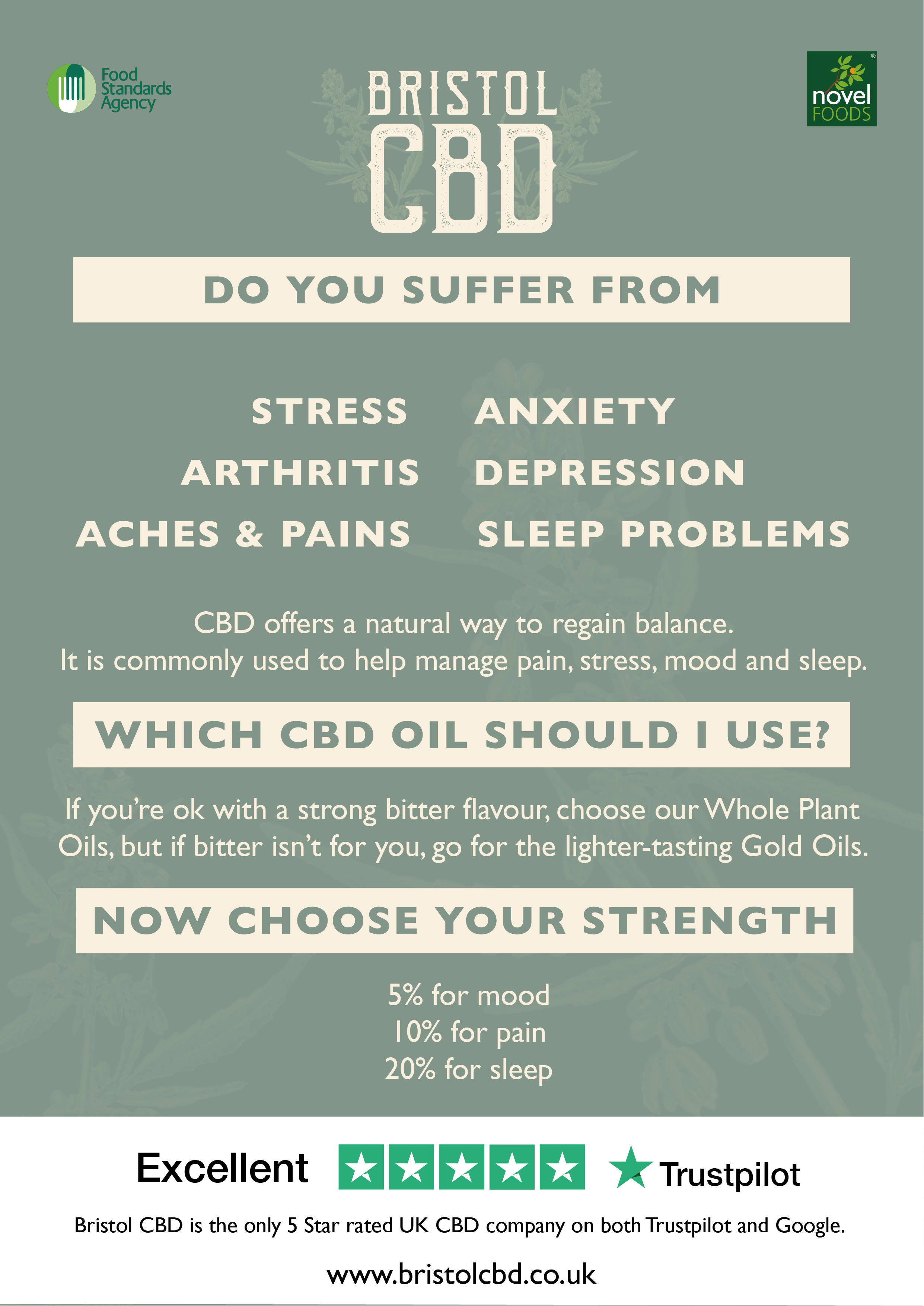
Please note: our staff are not qualified doctors or nurses, and we do not make medical claims or recommend CBD for specific ailments. All content is based on scientific research and years of practical experience. We always encourage speaking with your GP or healthcare provider before starting any new supplement.